
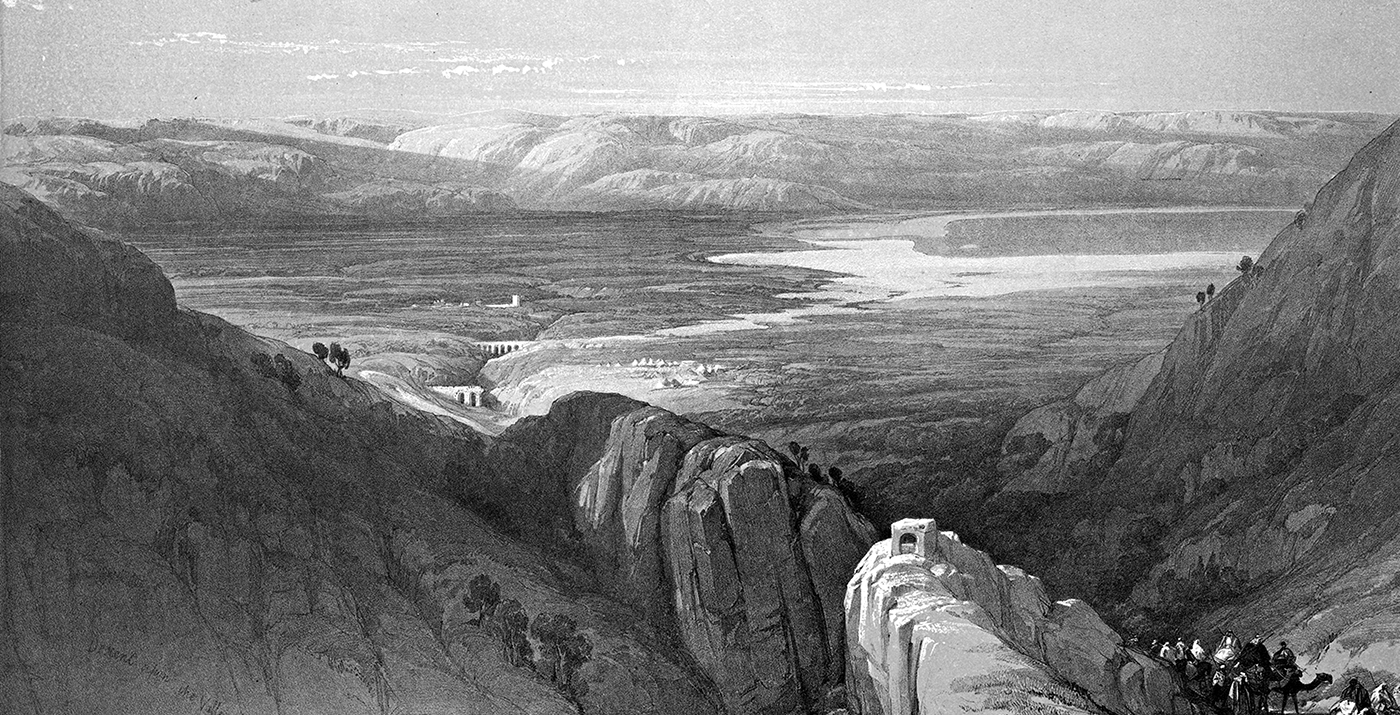
An expansive landscape scene in European Renaissance perspective: from an elevated position, the view expands upon sheer, mountainous rocks in the near distance that seem to be falling in slow motion
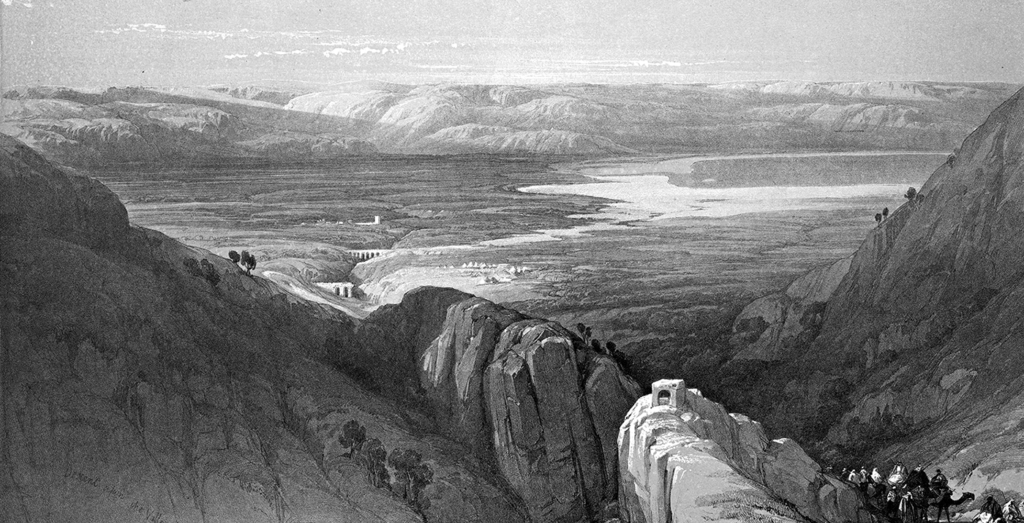
Descent upon the Valley of the Jordan, 1842–49. Dorot Jewish Division, New York Public Library. An expansive landscape scene in European Renaissance perspective: from an elevated position, the view expands upon sheer, mountainous rocks in the near distance that seem to be falling in slow motion. They give to a narrow path through which a group of robed travelers on camelback descend into a broad, treeless valley with an unruly river and several stone bridges. Beyond the valley gently rise another outcrop of bare mountains. Black and white engraving.
Kinship is often extended as another name for care, implying that with mutual reliance comes reciprocity. But who among us has not been disappointed by our families, both chosen and assigned? Or perhaps we betrayed our own voluntary responsibilities to others, or committed an error of misrecognition when we offered a pact of kinship that was not returned? For example, the house cat caught a garter snake and was playing with its writhing, bleeding body in one of my earliest memories. I rescued the snake carefully from the cat and held its head in my hand, looking into its eyes to ask if it was okay. It snapped open and shut its diamond mouth full of blood, trying to bite me. I was confused by this response to being rescued from death, and promptly released it into the grass, protecting it from the cat’s hunt. A week later, the snake reappeared in the garden, larger and marbled with scabs from its wounds. I was delighted to see it alive and tried to say hello. The snake did not recognize me and slithered away from my hopes for reptile kin. Perhaps its suspicion was that care is another name for control.